chinatraveldiary
Top Must-dos in Shanghai China Travel
6. Green Massage
.jpg)
Traditional Chinese acupressure is not for the weak. This isn't some oil-slicked Swedish relaxation or even the passive yoga that characterizes Thai massage. Chinese acupressure is a little like China itself: You may be blinking back tears of pain, but ultimately, it's a rewarding experience. Green Massage (98 yuan for 45 minutes), behind Huaihai Park, offers an experience that's a few notches above the thousands of hole-in-the-wall massages parlors in Shanghai. At Green, there are proper massage tables, clean pajamas to change into, soothing woodwind music and scented candles. None of that changes the fact that your body will be entering the space between pleasure and pain. Enjoy. Many travelers particularly request their tour agents to arrange the Green Massage in their China tour of Shanghai.
7. 50 Moganshan Road
.jpg)
Chinese contemporary art now sells at international auctions for gazillions of dollars. Derivative stuff is everywhere, so it's all the more important to head to the nerve center of Shanghai's buzzing art scene at Moganshan Road. A collection of once-deserted warehouses near Suzhou Creek, Moganshan now houses Shanghai's best contemporary art galleries. Best of all, several top artists, like Zhou Tiehai and Ding Yi, keep their studios here, so if you're lucky you can wander in and see the creative process unfold in real time. One of the city's oldest and most respected galleries is at 50 Moganshan, ShanghART, which represents the cream of the art world and is run by Swiss native Lorenz Helbling. The China travel service designed by any tour company is complete unless 50 Moganshan Road is arranged in their schedule.
8. The Bund
.jpg)
Yes, this riverfront boardwalk is touristy, a particular magnet for Chinese farmers in polyester suits who come to gawp at all the fashionable Shanghainese. But part of the fun of an amble down the Bund (it rhymes with fund) is checking out the Chinese checking out other Chinese. Recover from the crowds with a classic martini at the roof terrace of M on the Bund, located in one of the 1920s-era buildings that still line the riverfront. The M is for Michelle Garnaut, an Australian restaurateur who in the spring oversees Shanghai's very own International Literary Festival, which has in the past lured everyone from John Banville to Amy Tan. Walking around the Bund and discover the modern Shanghai would be a must-do in your China vacation packages of Shanghai.
9. Jishi
.jpg)
True Shanghai food is a world away from what you get at home in paper take-out cartons. The best place to try local eats is Jishi. The place is tiny and always crowded. The English menu is long and relatively incomprehensible. At the very least, order the following, even if you're dining solo: radish pickled in soy sauce (jiang luobo), tofu skin with mushrooms (fuzhu), cucumber with aged vinegar (pai huanggua), sweet-and-sour spare ribs (tangcu paigu) and minced dried tofu with wild greens (malantou). Those are the appetizers. Now, for the main courses: red-braised pork with bamboo shoots (hongshao rou he zhusun), fish smothered in scallions (congbao yutou), and a stir-fry of Yunnan ham with an untranslatable Shanghai vegetable that tastes like a cross between asparagus and green beans (luhao huotui). If it's crab season, definitely order the crab with vermicelli sheets (xiefen fenpi). Many students like to hang out the Jishi to taste the delicious local food there along their educational tours in China of Shanghai.
One more thing: That fish you just ordered? It's actually fish head — a giant carp's noggin, to be more specific. But you would have never known unless I told you. And if you didn't order it out of some misplaced squeamishness, you might have missed the best damn fish you will have ever tasted. These would be much useful when your are enjoying your China travel.
10. Vue Bar
.jpg)
Shanghai is a vertical city, so you should climb up and enjoy the view. The aptly named Vue Bar, located on the 32nd and 33rd floors of the new Hyatt on the Bund, offers tremendous vistas of both the historic waterfront and Pudong, the futuristic business district on the other side of the Huangpu River that looks like it was designed by George Jetson. Members of Shanghai's gilded class like to lounge on the daybeds or, in the summer months, take a dip in the whirlpool on the terrace. To any bar-lovers, they would never miss relaxing themselves in the Vue Bar along their last minute China travel deals of Shanghai.
 Commentaires textes : Écrire
Explore Baoding Old Tune in Hebei China
Old Tune which is also called Old Tune Clapper Opera, originates from the countryside area around Baoding City, is one of the oldest local operas in Hebei. It’s popular not only in Baoding but also in Cangzhou, Hengshui, Shijiazhuang, Xingtai, Handan, Zhangjiakou, Beijing, Tianjin and parts of Shanxi Province. If you are lucky enough, you may see people performing Baoding Old Tune when your China tours come to Hebei region.

During the process of the development of Old Tune, it was influenced by the local popular opera Gao Tune and Hebei Clapper Opera. It absorbed the artistic essence of local talking and singing forms. The regular professional society appeared in the period of Emperor Guangxu (1875-1908) in the Qing Dynasty and began to go into the cities. Then, it reached its peak period in 1930s. Many China tour agents have arranged the Baoding Old Tunen in their itinerary.

Baoding Old Tune is fervent, simple and good at telling a story. It’s also have complete professions. So it is fit for performing Paodai Opera and Group Opera whose themes are history stories. Its libretto is made up of sentences, each of which consists of seven or ten words, belongs to Ban Tune type. And the main modes are the first mode, second mode, third mode and bozi (loose mode) etc. The accompany instruments take the banhu as the dominant one and erhu, sheng as the accompanied ones. Its traditional plays include Cure the Bandit, Down to the East of the River, Lintong Mountain and Peaceful Town etc. It is no wonder that so many travelers particularly request their China travel agents to arrange the Baoding Old Tune discovery in their itinerary.

After 1949, the Gaoyang, Dingxian County and Fuping Professional Old Tune Troupes were founded in the area around Baoding. Baoding Old Tune Troupe has been to Beijing to perform for several times. It was praised as “There is a treasure in Baoding, Old Tune is not old” by Deng Xiaoping. The excellent plays Lawsuit Between Mr. Pan and Mr. Yang, Be Loyal till Thousands of Years which are performed by this troupe were filmed in 1960 and 1980 twice and were showed all over the country. These people have made great contribution to Chinese culture, even the China tourism of Baoding in some ways.

And the famous artists are Cui Chengtian, Liu Shouqiao and Wang Guanying etc. After the new period, Old Tune produces a lot of excellent plays, such as The Sun and the Moon Cross the Sky, Refuse the Order etc., which won prizes several times when they were shown in and out the province. They also became one of the favorite operas among village audience in Hebei, especially the area around Central Hebei. Why not extend your China travel to Heibei to discover the Baoding Tune in depth?
- Commentaires textes : Écrire
Discover the Folk Huaguxi Opera in Hunan China
Huaguxi is a form of Chinese opera originating in Hunan province. It is known in China for its earthy quality, and is often referred to as the "spicy" form of Chinese opera. Huaguxi is known to have existed as early as 1695, during the Qing Dynasty. Unlike other forms of Chinese opera, Huaguxi originally had only two roles. These including the xiao chou, a small male clown, and the xiao dan, a vivacious young girl. The female role was played by men until women entered Chinese opera in the early 20th century. In the mid-18th century, a xiao shen role was added. This role refers to handsome young males. If you are just planning to visit Hunan province along your China tours, watching the folk Huaguxi is highly recommended.

Most Huaguxi plays were originally xiao xi, short plays lasting an hour or less. These plays often dealt with everyday rural life. With the rise of professional Huaguxi performers and performances in the capital city of Changsha, longer plays, daxi began to be performed. These plays dealt with grander themes of social satire and class struggle. Like other forms of Chinese opera, Huaguxi is staged with very few props. Music accompanying Huaguxi reflects the Changsha dialect spoken in Hunan. It is played with instruments like the datong (fiddle), yueqin (moon lute), dizi (bamboo flute), and suona (oboe). Percussion instruments provide the basic tempo for the performance. No China travel service designed for discovering Hunan province is incomplete if exploring folk Huaguxi is not arranged in their schedule.

Throughout much of its history, Huaguxi could not be performed legally because of the perception that it was an obscene form of opera. It was officially recognized by the People's Republic of China in 1952, but restrictions were placed on the type of material that could be performed. It is no wonder that so many last minute deals for China travel of Hunan discovery have arranged the Huaxi discovery activity.
May you have witness the natural beauty of China in the China vacation packages, while to discover an authentic China, Chinese culture is also an important part. Huagu, as a reflection of Chinese local folk culture, would be a must-have along your Hunan trip.
- Commentaires textes : Écrire
Discover Tibet's Mangkam: the Paradise for Snub-Nosed Monkeys
The number of Yunnan snub-nosed monkeys, a rare primate species, in Tibet's Mangkam Nature Reserve, has soared to 600 from 50 since the reserves' establishment 24 years ago. The monkeys mainly live in deep forests or on high mountains in Tibet's Mangkam County and Yunan's Deqin Prefecture, with its number estimated at 2,000 all over the country. If you are enjoying your China tour of Tibet with your children, Tibet's Mangkam would be a good getaway for you.

The number of Yunnan snub-nosed monkeys, a rare primate species, in Tibet's Mangkam Nature Reserve, has soared to 600 from 50 since the reserves' establishment 24 years ago. Because of rampant poach, the number of this precious animal plummeted from 2,000 in the 1960s to no more than 60 in the early 1990s, according to the Mangkam County Forestry Bureau. It is no wonder that so many China tour agents have arranged the Tibet's Mangkam into their itinerary designed for family tours.

Meanwhile, as the monkey groups live in scattered places and are separated from one another, their breading is also limited by seldom gene exchanges between natural populations. The monkeys mainly live in deep forests or on high mountains in Tibet's Mangkam County and Yunan's Deqin Prefecture, with its number estimated at 2,000 all over the country. Discovering the snub-nosed monkeys would be a much interesting experience along the China tour deals of your children.
Lying at an altitude of 3,500 to 4,500 m, the 1,853-sq-km Mangkam Nature Reserve was set up in 1986 to protect primitive forest landscape and wildlife including Yunnan snub-nosed monkeys, snow leopards, clouded leopards and wild oxen. Why not take a China vacation packages of Tibet and discover this paradise for snub-nosed monkeys in depth?
- Commentaires textes : Écrire
Top Attractions Recommended for Zhejiang China Travel
NO.2 Mount Putuo
Mount Putuo, or Putuo Mountain, is one of the Zhoushan Islands in Zhejiang Province. Along with Mount Emei in Sichuan, Mount Wutai in Shanxi and Mount Jiuhua in Anhui, it is one of the four sacred mountains in Chinese Buddhism. If you are a scared Buddhist, you should never miss watching the Mount Putuo along your China travel.

Putuo Mountain Island is 8.6 kilometers (5.34 miles) long from north to south, 3.5 kilometers (2.17 miles) wide from west to east and covers an overall area of 12.5 square kilometers (1,250 hectares). It is located in China's Eastern Sea and truly testifies to the timeless beauty of mountains and oceans. Its main peak, the Peak of Buddhist Top, is located at 300 meters above sea level. It is one of the first National Key Scenic resorts in China. Mount Putuo, as a must-see in Zhejiang province China, has contributed greatly to China tourism of Zhejiang province.
NO.1 West Lake
Located west of Hangzhou, Zhejiang Province, the West Lake is a fresh water lake renowned for its natural surroundings and history. Its beauty earned itself the nickname"paradise on earth." If you only have time one attraction in your China tour packages of Hangzhou, West Lake would be it.
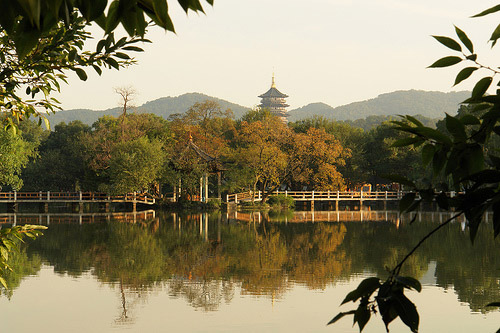
Surrounded by mountains on three sides, the lake covers an area of 6.5 square kilometers (650 hectares). On average, the lake is 3 meters deep. It has numerous temples, pagodas, gardens, and artificial islands located within. The lake's 11 sections flaunt over 100 scenic spots! It is no wonder that there are so many popular last minute deals for China travel designed for discovering the West Lake.
Every year, the lake area is buzzing with tourists and locals between the months of June and September, when its lotus flowers are in full bloom. The beauty of the lake has been described and depicted in many Chinese poems and landscape paintings. The West Lake was made a UNESCO World Heritage Site in 2011, and was described as "over time having influenced garden design across China as well as Japan and Korea." Why not extend your China business tours to Hangzhou to discover the West Lake so as to refresh yourself completely?
- Commentaires textes : Écrire